Stretched out in the sun like a cat, my pale skin soaks up the initial rays of spring. I’ve shed my sweatshirt for the first time in what feels like an eternity. We didn’t really get much of a winter this year—just a rainy season. Honestly more like a flood season. So I welcome today’s clear blue skies, warm sun, even the breeze whisking in off the prairie.
I’m away on my own for a mini retreat of silence and solitude. No people, no demands, just relaxation and peace. I laze in the sunlight attempting to pray, to meditate, to commune with my loving God, but it’s laughable. My mind flip-flops from one anxious thought or question to the next. I power off my phone so I’m not tempted to chase every to-do that pops into my head. Even so, an hour later, my brain is still ricocheting like a pinball machine.
A crow caws loudly on the fence in front of me and I shout at him “No! Too loud! Go away!” Then I snicker at this irrational anger; the crow is a personification of my internal world. There is so much rattling around up there that I’m not even sure what I’m thinking, what I’m asking, what I want to know. I try to sort through it as I talk to God, but it’s a jumbled mess. “No! Too loud! Go away!” I hear myself repeat, this time at the real culprit inside my head.
I give up, frustrated. The normally contemplative part of me is irritated at my complete inability to settle. “Well Katie, This is the result of a busy few weeks,” I try to tell myself with compassion. “It might take a few hours to come down.”
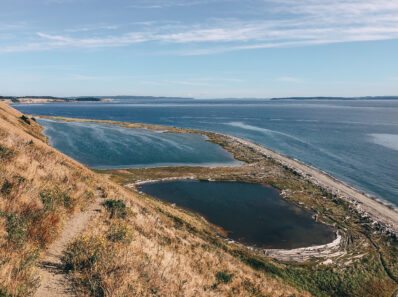
Maybe a run will do it, shake me out of this sour mood, burn off some of this restless energy. I tie up my laces and head to the beach.
Step, step, step, breathe.
One, two, three, breathe.
I pound it out on the sand, but all it does is give rhythm to my racing thoughts, a cadence to the questions.
Step, why this?
Step, what about that?
Step, what if this?
Breathe.
I smile as I remember telling my son over breakfast this morning, “You didn’t even let me answer your first question before you asked another.” I can almost see the humor in my Father’s quirked smile, the twinkle in his eye. The irony of our sameness.
My oldest child has always been a professional question-asker. His curiosity never sated, he stacks questions on top of questions until my overstimulated brain simply runs out of steam. I keep a running list in my phone of the questions I told him we could explore together later. “Mom’s brain is tired right now, but let’s write that one down so we can look it up later.” I can’t fault him for this desire to understand, I know exactly where he inherited it. Both thumbs point back at me. Some people seem content to accept things as they are. But for the rest of us, the need to know, to understand, is written in our DNA.
Plenty of questions just require a quick internet search, or a video of someone breaking it down much better than I would. But many, especially as my kids get older, do not have easy, black and white answers. Many of their questions are nuanced and layered and just plain difficult. I find myself saying “that’s a tough one, let’s study that together.” Or “I struggle with that question too. Here are my thoughts, but I’m not sure I really have an answer.”
These kinds of questions reveal our limitations—our lack, our humanity. They uncover all of the things from which we might be running.
Somewhere along the way into adulthood, we lose some of our childlike inquisitiveness. We run into tough questions and our egos begin to resist, preferring certainty, clean edges, and answers we can hold up as proof. Hard questions dismantle that illusion. Our fears are drawn into the light—fear of the unknown, fear of rejection, fear of losing control, fear of what it means if there are no easy answers. When we ask why or how, we are admitting unrest. We are confessing that something feels unresolved, unsettled, unfinished. Our unanswered questions remind us that we are not self-sufficient, that we do not see the whole picture, that we are dependent creatures living inside mystery.
Step, step, step, breathe.
One, two, three, breathe.
I’m praying now as I run, God help me with all these tangled thoughts, this unsettled energy. I force myself to repeat a simple phrase over and over to the rhythm of my feet.
Christ loves me.
Christ loves me.
Christ loves me.
It takes two miles before I finally feel my soul.
Now I’m walking along paths I know well, the sound of my once thumping feet replaced by the the inhale and exhale of waves on the shore. And finally my mind is quiet. The alien expelled by motion, I am once again familiar with myself.
The questions are still there, but they are distilled. What rises to the surface is clearer, more focused. I let them roll out of me like my son did over breakfast this morning—unfiltered, unashamed.
The militant relentlessness of my pounding feet has given way to the steady pulse of the ocean surf.
Waves in, waves out.
Breathe in, breathe out.
I toss my questions without restraint and then release them to the waves, no longer gripping for control or fearing the unanswered. My curiosity knows no bounds. I see myself as beloved by God and it stills me.
And I think—how do I carry this into my everyday life? Replace my anxious worry with childlike wonder? What makes this possible?
The answer has been with me all along, in the liturgy I’d been stamping into my psyche for the last mile.
Christ loves me.
Love—the kind that creates security. It doesn’t erase all of the questions, but it communicates, even if you don’t have all the answers, that you are still safe. That you belong.
One of the first ways we mark a person with security and belonging is by giving them a name. A name is a way of claiming another as our own, of folding them into ourselves. We see this in the naming of a child, in the renaming that often accompanies marriage. To name someone is to say, you are mine. I choose you.
When God named His children, the collective body of people who followed after him, this is the name He chose: Israel.
And do you know what it means?
“Those who wrestle with God.”
He did not name them for their gold-star achievements or shining moments. And it’s a good thing, too, because much like all of us, they were inconsistent—back and forth, stumbling, wandering. God named them not for their victories, but for their persistence, for the way they kept clinging to Him, unwilling to let go.
Despite this truth, when we find ourselves wrestling with difficult questions, the ones that stir anxiety and unease, it can be tempting to tuck them away. To ignore them entirely or to cover them with false certainty. We settle for pat answers that offer a thin sense of comfort because we are deeply uncomfortable with what we cannot fully understand or explain. Then we keep our worlds busy and loud, literally driven to distraction, as we ignore the ache of our own internal restlessness. We can’t live a moment alone with our thoughts, alone with God, because in the silence, everything we have stuffed begins to rise.
But what if we didn’t?
Waves in, waves out.
Breathe in, breathe out.
What if we were not meant to escape our discomfort, but to lean into it? Questions do more than simply expose our uncertainty, they teach us. They teach us about ourselves. And the responses we receive, or do not receive, teach us about the one to whom we are asking. Questions can build relationship. They have the potential to create connection.
I am reminded of the many honest conversations I have had with my children about death and the afterlife and the existence of pain—you know the ones I’m talking about. The ones that stir up all sorts of personal doubt and anxiety, that you wish you could outsource to literally anyone else. But instead, I hunker down and pull them close. I embrace them as I share what I believe, but also what I wrestle with. I show them that they are not alone in their questioning and that even when the answers remain unclear, the questions bind us to one another. And I choose to welcome it, not run from it, just like my Father does with me.
Ultimately, when we turn our questions toward our Creator, they bind us to Him as well.
God made us to keep seeking, to keep longing, like explorers moving through the murky unknown with lanterns held high. And as we do this, our hearts become knit with his. He is present in the wrestle—meeting us as we reach out for Him in the midst of it. He draws near to us in our questions, sometimes offering answers, but always offering Himself. Calling us by name. Calling us His own.

Just finished When God doesn’t fix it by Laura Story; you would enjoy it; she has lots of questions, too❤️
Awww, the waves
They can drown out the other voices
What a gift, the rythmn, the calming
You captured this ever changing journey with this personal experience.
Thank you